Modular vs Smart Telescopes: What Each One Actually Delivers
One costs $499 and takes two minutes to set up. The other costs five times more and needs a spreadsheet to plan. Here is what you actually get from each, and when one makes more sense than the other.
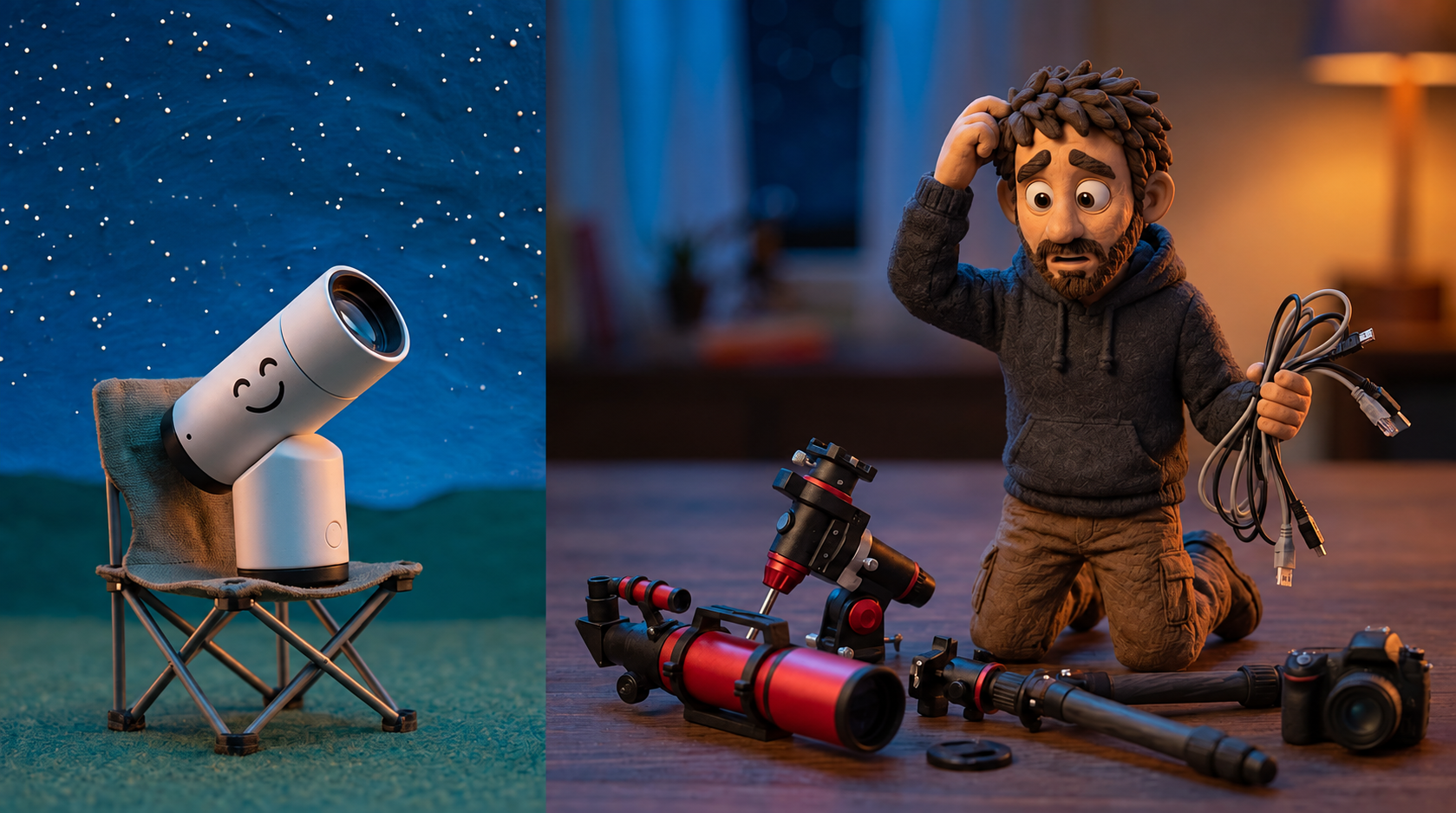
A Seestar S50 costs $499 and produces a color image of the Orion Nebula in under a minute. A modular rig (separate mount, telescope, camera, filters, computer, and guiding) starts around $2,500 and can take an hour to set up before capturing a single frame.
On paper the smart telescope looks like a clear win. But the people asking "should I move from a dedicated AP rig to a smart scope?" on Cloudy Nights are not asking which one is cheaper. They already own both, or they are about to, and what they are trying to figure out is which one to reach for on a given night.
This is not a "one is better" comparison. It is a map of the trade-offs, so you can decide which gaps you are willing to live with and which ones will ruin a session.
What a Smart Telescope Does That a Modular Rig Cannot
Setup in minutes, not hours. A Seestar S50 or Dwarf 3 goes from the box to a live stacked image in two to five minutes. No balancing, no polar alignment, no cable management, no guiding calibration. You place it, power it, open the app, pick a target, and the scope platesolves, tracks, stacks, and saves a finished image to your phone.
Portability you do not think about. Most smart telescopes weigh between three and five pounds and fit in a small backpack. They go on family trips, to a friend's backyard, or out to a dark site without needing a second bag for accessories.
Imaging from light-polluted backyards that works. Because the built-in stacking and live processing handle short subs with aggressive rejection, a smart scope in a Bortle 8 backyard produces a recognizable nebula. A modular rig in the same sky would need narrowband filters, longer integration, and heavy processing to match it.
Results before the night is over. A smart scope stacks as it goes. By the time you pack up, the image is done. There is no morning of calibration frames, stacking, and processing before you see what you captured.
What a Modular Rig Does That a Smart Telescope Cannot
Aperture that resolves detail. A 50 mm smart telescope shows Saturn as "a bright oval with a barely visible ring stub." An 8-inch SCT on a modular rig resolves the Cassini Division, banding on Jupiter, and surface features on Mars. The aperture gap is not something software can close.
An upgrade path that lasts decades. A modular rig is a system of independent parts. You can swap the camera for a newer model with a different sensor or lower read noise. You can replace the mount when you outgrow it. You can add a filter wheel, switch from OSC to mono, or move the whole optical train to a different OTA. A smart telescope is a sealed unit. When the manufacturer stops updating the app (typically three to five years after launch), the scope becomes a paperweight.
Total control over the capture. With NINA, Voyager, or APT, you set exposure time per filter, dither between every sub, choose your dither settle threshold, pause when clouds roll in, resume when they clear, trigger flats at dawn, and shut down when the sequence is done. A smart telescope abstracts all of that away. That is the point. But if you want to push your data past what the built-in processing can do, you have no knobs to turn.
Raw data, not processed JPEGs. A smart telescope gives you a stacked, stretched, and color-balanced image. That is great for sharing. But the raw frames the sensor captured are either not accessible at all or buried inside a proprietary format. A modular rig gives you FITS files. You calibrate them, stack them in your chosen software, and process every channel independently. The difference matters when the target is faint, when the gradient is stubborn, or when you want to extract the last bit of signal from a 10-hour integration.
Software freedom. The app that runs your smart telescope is written and maintained by one company. If they decide to change the API, charge a subscription, or stop supporting your phone's OS, your hardware is affected. A modular rig runs on open-source or commercial software that you can replace or customize. NINA, PHD2, ASTAP, and Ekos are maintained by communities, not by a single hardware vendor.
Where the Two Overlap (and Where They Do Not)
For bright nebulae (Orion, North America, Elephant's Trunk) shot from a reasonably dark sky, both systems produce recognizable, shareable images. The smart scope does it faster and with less effort. The modular rig does it deeper and with more flexibility in post-processing. The gap widens fast as targets get fainter or smaller.
For galaxies smaller than a few arcminutes across, for planetary nebulae, for any object that benefits from resolution over signal, the smart scope runs into its aperture ceiling. The modular rig keeps scaling up as long as the mount can track it.
For planetary imaging, the comparison is not close. A smart scope does not have the focal length or the resolution. A modular rig with a planetary camera and a 10-inch SCT produces frames that resolve detail at the diffraction limit.
The Real Question Is Not Which One to Buy
Most people who end up in these discussions already own something. The real question is "what do I do when I want what the other category offers?"
If you own a smart scope and want aperture, control, and raw data, the conventional answer is a $3,000 investment and a learning curve measured in months. There is another path: a remote session on a modular rig that is already set up, aligned, and running under Bortle 1 skies. You book it, upload your sequence, and download calibrated FITS files the next morning. No purchase, no collimation, no cables to manage.
And if you already own a modular rig but find yourself envying the instant-start convenience of a smart scope, the honest answer is that they solve different problems. The modular rig is for the nights when you want control and depth. The smart scope is for the nights when you want a picture before dinner.