OSC vs Mono: Choosing a Camera for Astrophotography
The difference between one-shot color and monochrome cameras, the trade-offs of each, and why a one-shot color camera is such a good fit for fast, approachable deep-sky imaging.
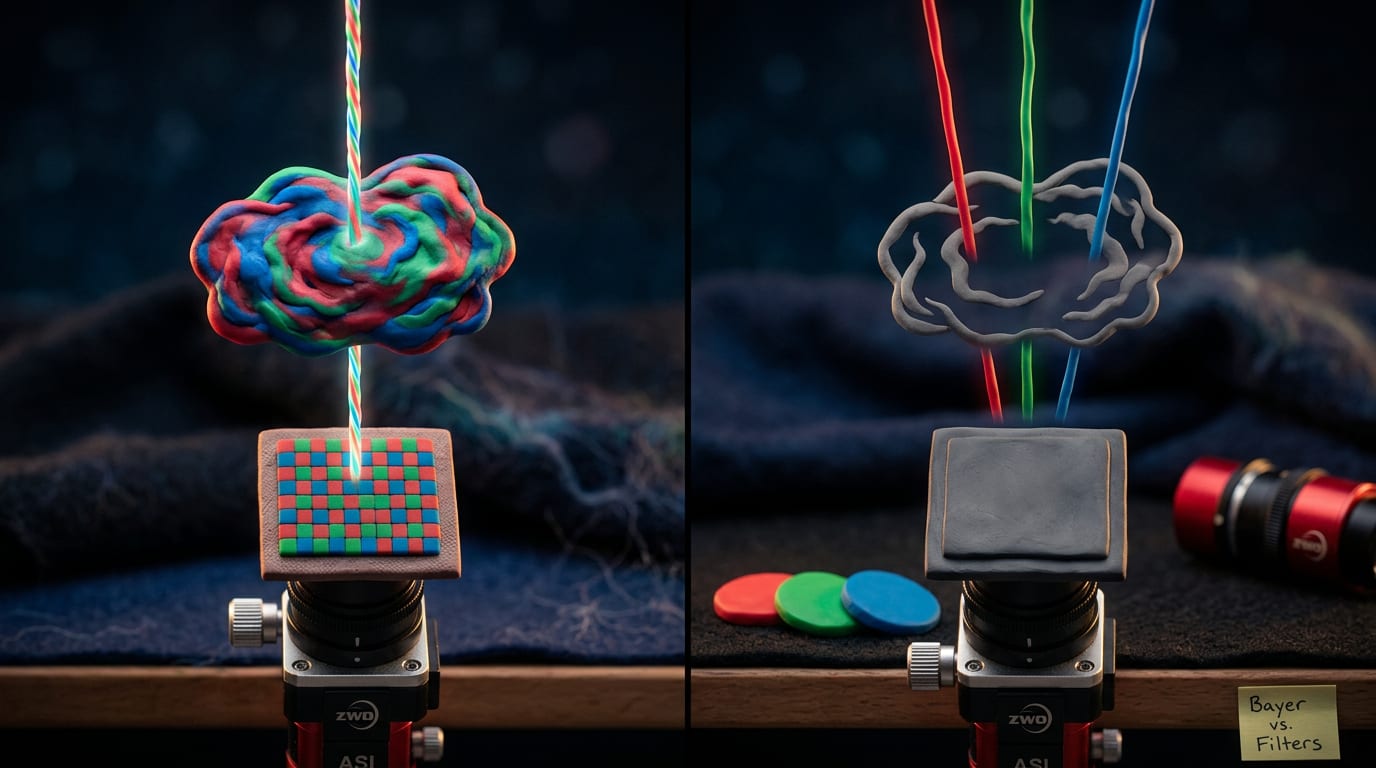
Once you decide to image deep space, one of the first real choices is the camera, and it comes down to two families: one-shot color and monochrome. They take very different paths to the same goal, a colorful image of a faint object, and each suits a different kind of imager and a different amount of time.
One-shot color (OSC)
A one-shot color camera works much like the camera in your phone. A tiny grid of red, green, and blue filters sits directly over the sensor, so a single exposure already records full color, and software reconstructs the image from that mosaic. The appeal is simplicity and speed: one set of exposures gives you a finished color picture, with no filters to swap and far less to manage during the night.

Monochrome (mono)
A monochrome camera has no color filters at all. Each pixel simply records brightness. To build a color image you shoot the same target several times through separate filters, red then green then blue, and combine the results afterward. Because no color filter array is stealing light from each pixel, a mono sensor is more sensitive and resolves finer detail. It also unlocks narrowband imaging, where filters isolate the light of specific elements to create the dramatic, high-contrast look behind many famous nebula photographs.
The trade-offs
OSC is easier, faster, and cheaper, and produces a color image in a single session. It is a little less efficient and slightly lower in resolution because of its built-in color filters.
Mono delivers the most sensitivity, the finest detail, and the full flexibility of narrowband palettes. In exchange it needs a filter wheel, many more exposures, several times the time on each target, and more complex processing.
Which one is right?
For a beginner, for limited time, or for anyone who wants a satisfying color image without a complicated workflow, one-shot color is the natural starting point. It also pairs beautifully with a dual-band filter, which lets a color camera punch well above its weight on emission nebulae under a dark sky. For the advanced imager chasing maximum quality, full narrowband palettes, and the sharpest possible detail, and willing to invest many hours per target, monochrome is the tool.
What we use, and why
Our rig runs a one-shot color camera, and for remote sessions that is a deliberate choice. It produces a complete color image in a single night, keeps the workflow approachable for newcomers, and, paired with a dual-band filter under Bortle 1 skies, still delivers striking results on nebulae. You get most of the reward without the extra hardware, the extra nights, and the extra complexity.