Choosing the Right Telescope for Astrophotography
Refractor, reflector or compound? A plain-language guide to matching a telescope to the targets you want to shoot, your budget, and your patience.
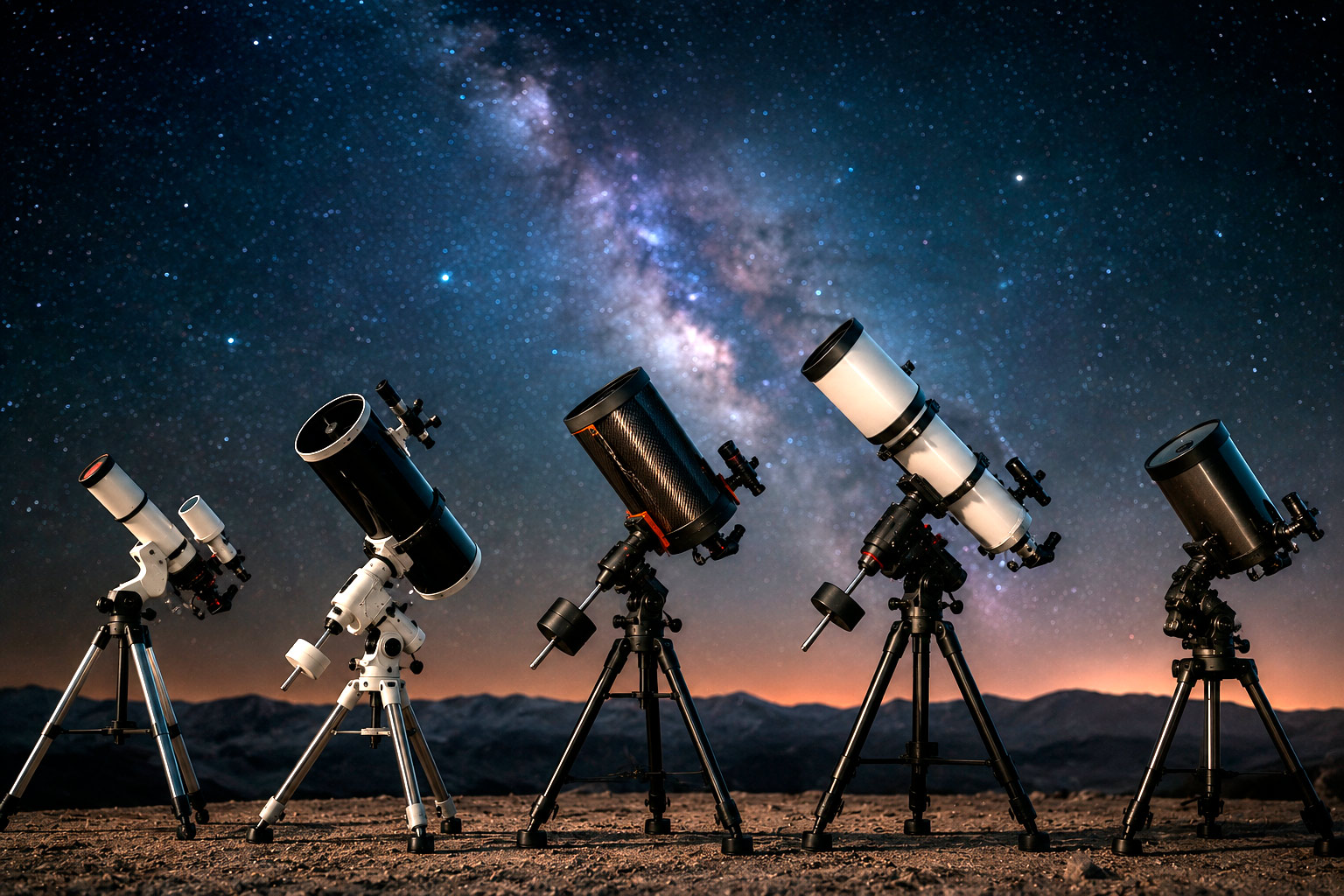
One of the most common questions among astrophotographers is: Which telescope should I buy? The answer depends on the type of objects you want to image, your experience level, and your budget. Each telescope design has strengths and weaknesses, making it better suited for certain targets than others.
Refractors
Refractors use lenses to focus light and are often considered the gold standard for deep-sky astrophotography.
Advantages
Sharp, high-contrast images
Minimal maintenance
No need for collimation
Lightweight and portable
Best For
Nebulae
Large galaxies
Star fields
Widefield astrophotography
Popular aperture ranges:
50mm to 80mm for widefield imaging
80mm to 120mm for more detailed deep-sky work
For many astrophotographers, an apochromatic refractor is the ideal first telescope.
Newtonian Reflectors
Newtonians use mirrors instead of lenses, providing large apertures at relatively low cost.
Advantages
Excellent value for money
Fast focal ratios
Large light-gathering capability
Best For
Nebulae
Galaxies
Smaller deep-sky targets
Considerations
Require periodic collimation
Larger and bulkier than refractors
Usually need a coma corrector for astrophotography
Many advanced imagers use astrographs based on Newtonian designs because of their speed and efficiency.
Ritchey-Chrétien Telescopes
Often called RC telescopes, these are commonly found in professional observatories.
Advantages
No chromatic aberration
Excellent edge-to-edge correction
Long focal lengths
Best For
Galaxies
Planetary nebulae
Small deep-sky objects
Considerations
More demanding to collimate
Require precise guiding
Less forgiving for beginners
RC telescopes shine when capturing tiny objects that benefit from high magnification.
Schmidt-Cassegrain Telescopes (SCTs)
SCTs combine mirrors and lenses in a compact design.
Advantages
Long focal length in a compact tube
Versatile design
Excellent for small targets
Best For
Galaxies
Planetary nebulae
Lunar imaging
Planetary imaging
Considerations
Slower focal ratios
Can require focal reducers for deep-sky work
The popular Celestron EdgeHD series has become a favorite among advanced astrophotographers.
Maksutov-Cassegrain Telescopes
Known for their compact size and sharp optics.
Advantages
Excellent optical quality
Compact and portable
Very good for high magnification
Best For
Moon
Planets
Double stars
Considerations
Generally too slow for deep-sky astrophotography
Narrow field of view
These telescopes are often chosen by planetary imagers rather than deep-sky photographers.
Which Telescope is Right for You?
If your primary interest is photographing nebulae and large deep-sky objects, a small to medium apochromatic refractor is often the best starting point.
If you want maximum performance per dollar, a Newtonian astrograph offers tremendous value.
If your goal is to capture distant galaxies, planetary nebulae, or tiny deep-sky objects, an RC or Schmidt-Cassegrain may be a better choice.
The most important lesson in astrophotography is that bigger is not always better. A high-quality refractor with a modest focal length often produces more successful images than a large, complex telescope that is difficult to operate. Matching the telescope to your targets and experience level will usually lead to the best results under the stars.