Why Autoguiding Is the Real Reason Stars Stay Round
No mount tracks perfectly. Autoguiding watches a guide star and corrects every drift in real time, turning what would be streaks into round, sharp stars across two to five minute sub-exposures.
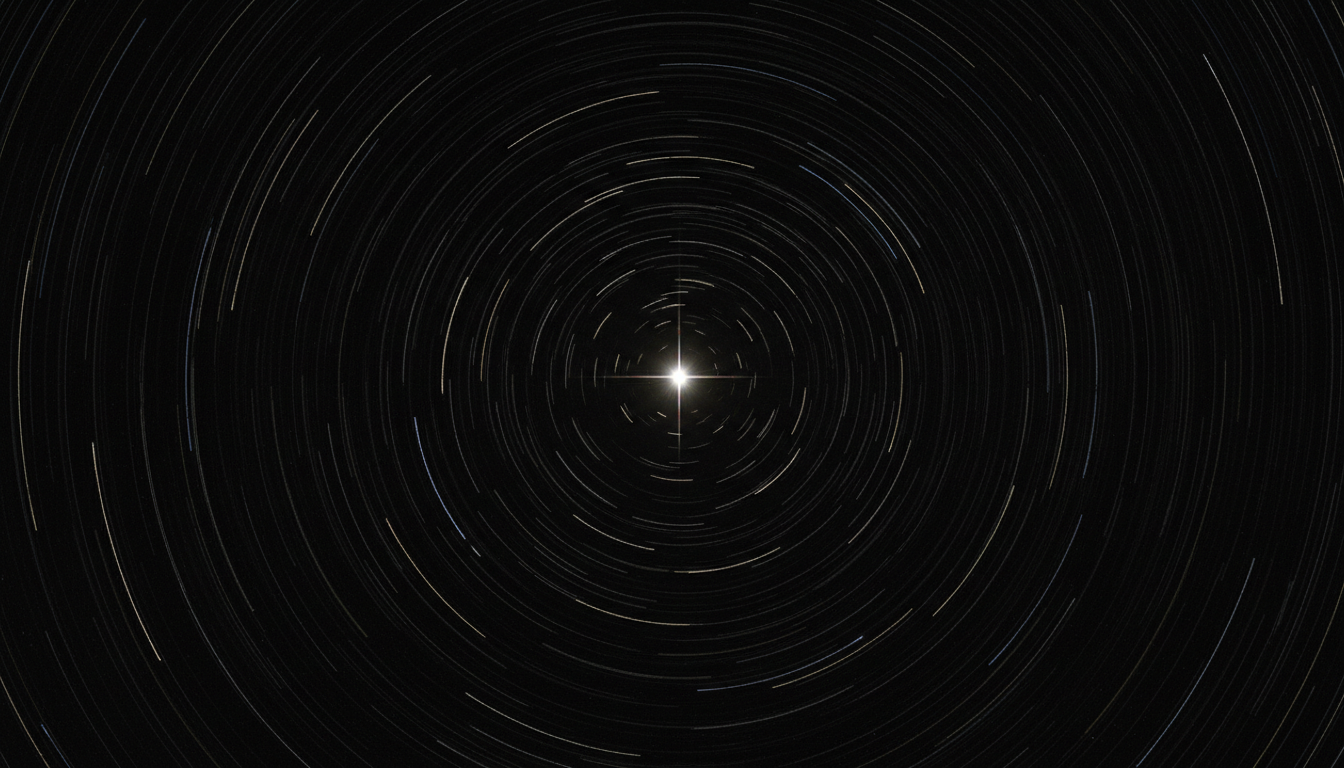
A five minute sub-exposure begins. Focus is set, the mount is on target. When the frame finishes, the stars are not round. They trail, wobble, or stretch into ellipses. The reflex is to blame the mount. But no mechanical mount tracks perfectly. The Earth rotates, the atmosphere bends light, wind shakes the tripod. A mount can be excellent and still drift by several arcseconds over a minute. For deep-sky imaging at typical focal lengths, that is enough to soften a frame.
What autoguiding does
Autoguiding is a closed-loop correction system. A separate camera and scope (the guide scope) take short exposures of a guide star while the main camera captures the target. Each time the guide star moves even slightly from its reference position, the software sends a correction pulse to the mount to bring it back. The guide exposures run every one to three seconds, all night, without any intervention.
The result: the main camera sees stars as round points, even during a five minute sub-exposure. Most mounts show visible drift in under sixty seconds at the focal lengths used for deep-sky imaging. Autoguiding removes that drift entirely, letting the imager stack clean sub-exposures for hours of integration time. Sub-exposures of two to five minutes are standard in modern deep-sky imaging, and autoguiding makes those durations reliable even on nights with light wind or mediocre seeing.
Guide scope and guide camera
Two extra pieces of hardware make autoguiding possible. A guide scope is a small refractor, usually between 30 mm and 60 mm aperture, that rides alongside the main telescope. Its wider field of view makes it easier to find a guide star anywhere in the sky. The guide camera is a dedicated sensor, often monochrome and sensitive, that captures frames of that star at high speed.
Most guiding setups communicate over USB. The guide camera sends frames to the guiding software, the software calculates the correction, and the software tells the mount to move. The exposure itself takes one to three seconds, but the calculation and the correction pulse together take under a second. The full loop runs continuously, every few seconds, for the entire night.
Calibration: set once and reuse
Before guiding can begin, the system calibrates. It moves the mount in known steps and measures how the guide star responds. This tells the software how many pixels of movement correspond to a real arcsecond of sky, and in which direction each motor axis moves.
A common question is whether this calibration must be repeated every night. With modern guiding software such as PHD2, a good calibration can be reused across many sessions provided the equipment configuration has not changed. Disconnecting the guide scope, rotating the camera, or changing the load on the mount all demand a fresh calibration. But if the hardware stays the same, the same calibration file can serve night after night. One less thing to configure at the start of a session.
Why two to five minutes works
Newcomers sometimes ask why not take one very long exposure and skip autoguiding altogether. The answer is that the mount cannot hold a star perfectly stationary for more than a minute or two at imaging focal lengths. Beyond that, periodic error and slight polar misalignment accumulate and turn stars into streaks.
Autoguiding resets that accumulation every few seconds. Instead of fighting against drift for ten minutes, the system corrects while drift is still measured in pixels. That is why deep-sky images are built from many sub-exposures of moderate length, stacked later in processing. Autoguiding ensures each sub-exposure is sharp, so the stack builds on clean data.
Dithering: an extra benefit of autoguiding
Once autoguiding is in place, the same software can dither. After every sub-exposure, the mount shifts the framing by a few pixels in a random direction. This moves the sky relative to the sensor's fixed pattern of noise and defects. Hot pixels, fixed pattern noise, and walking noise stay in the same place on the sensor, but the stars and background shift slightly between frames. During stacking, the software rejects what does not move with the sky, leaving a clean background. Dithering is one of the most effective ways to clean a final image, and it costs nothing once the guiding loop is running.
Matching guide scope to main scope
Selecting a guide scope is not about focal length ratios alone. What matters is whether the guide camera can detect the same small movements that affect the main camera, and that means comparing image scales. Image scale in arcseconds per pixel is calculated as (pixel size in micrometres / focal length in millimetres) x 206.3. A guide camera operating at a coarser scale than the main camera sees drift later and measures it less precisely.
The guiding scale should ideally be no more than about four times the main camera scale. Beyond that ratio, the guide star moves less than a pixel on the guide camera while drifting several pixels on the main sensor, and guiding becomes unreliable. For example, a main scope at 1.0 arcsec per pixel paired with a guide scope at 3.5 arcsec per pixel is workable, but a guide scale over 5 arcsec per pixel will struggle to keep stars round at that focal length.
At long focal lengths, above roughly 1500 mm, a separate guide scope becomes difficult to match. The guide focal length would need to be impractically long to keep the scale ratio within range, and differential flexure between the two optical tubes adds errors that no amount of calibration can remove. For these setups, an off-axis guider (OAG) is the standard choice. An OAG picks up guide star light from the same optical path as the main camera, eliminating flexure and mirror flop, and guaranteeing that the guide star and the imaging field move together.
Autoguiding as the backbone of a remote session
In a remote observatory, autoguiding becomes even more important. No one is standing next to the mount to tweak the hand controller when the wind picks up. The guiding software runs unattended, correcting drift all night. If a cloud passes and the guide star is lost, the software can pause imaging and wait for the star to reappear. This kind of resilience is what makes remote deep-sky imaging practical. The system handles the small corrections while the imager sleeps or works on processing earlier data.
A well configured remote observatory has the guiding calibration dialled in before anyone books a session. The guide scope is locked, the camera rotation is fixed, and the calibration file has been tested across multiple nights. That means the first sub-exposure of the night is already sharp. No lost time tuning settings or running a calibration routine in the dark. The session starts by framing the target and hitting go.
Autoguiding is not a luxury add-on for long exposures. It is the mechanism that makes long exposures possible in the first place. Without it, the mount's imperfections set a hard limit on sub-exposure length that no amount of processing can undo. With it, the only limit is how much sky time is available.