What Is Seeing and Why It Sets the Limit on Sharpness
Atmospheric seeing controls how sharp stars appear through a telescope. Twinkling is the visible sign of air in motion, and the difference between a steady night and a turbulent one often matters more than the quality of the optics.
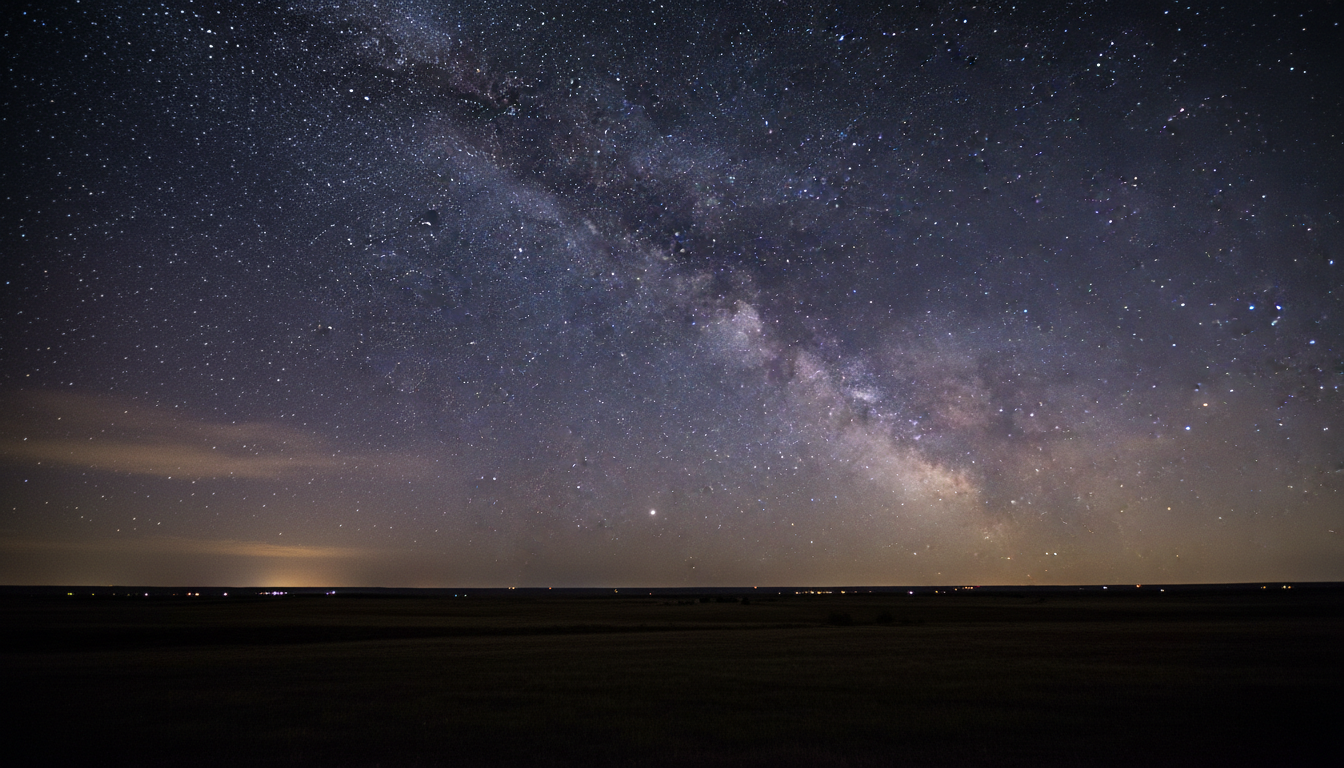
On some nights the stars blaze steady and still, and on others they dance, shimmer, and flash with color. That restlessness has a name in astronomy: seeing. It is the single biggest thing the atmosphere does to a deep-sky image on any given night, and reading it is part of what separates a productive session from a frustrating one.
Why stars twinkle
Starlight travels in a straight line across light years of empty space, and then in the last fraction of a second it hits the atmosphere. The air is never perfectly still. It is full of pockets at slightly different temperatures and densities, all moving and mixing. Each pocket bends the passing light by a tiny amount, and because the pockets keep shifting, the bending changes from moment to moment. To the eye that is twinkling. To a camera collecting light over several seconds, it is blur: stars bloat and the finest detail smears.
Seeing is measured in arcseconds
Astronomers measure seeing by how wide a star's image becomes, in arcseconds, where an arcsecond is one 3,600th of a degree. On a good night, seeing might be 1 to 2 arcseconds. On a poor, turbulent night it can run 3 to 4 or worse, and the best mountaintop sites occasionally drop below 1. The smaller the number, the sharper the sky, and the more fine detail the optics can actually deliver.
Seeing is not the same as transparency
Two different qualities describe how good a night is, and keeping them separate helps when evaluating a prospective imaging site:
- Seeing is how steady the air is. It controls sharpness and fine detail.
- Transparency is how clear and clean the air is, free of haze, humidity, and thin cloud. It controls how faint a target can be captured.
A night can be crystal clear but turbulent, producing deep but soft frames, or rock steady but hazy, producing sharp but shallow ones. The truly great nights offer both at once.
What makes seeing good or bad
- The jet stream. Fast high-altitude winds stir the upper atmosphere and can wreck seeing even on a perfectly clear night.
- Local heat. Warm ground, rooftops, and pavement release rising thermals that ripple the air just above them. This is one reason rural sites far from buildings and asphalt produce steadier skies.
- Stable, settled air. Dry, calm weather over a good site gives the steadiest seeing of all.
Why it matters for deep-sky imaging
Seeing sets a practical limit on resolution. The finest detail, the smallest galaxies, and high-magnification views suffer the most when the air is turbulent. Wide-field deep-sky imaging is more forgiving than high-magnification work, but seeing still shows up as tighter or fatter stars and more or less resolved structure. Imagers cope in two ways: by stacking many frames, which averages out the wandering, and by choosing the steadier nights. A dark, dry, stable site is not only darker; it is often steadier too.
West Texas, where the ScopeBnB rig operates, sits under a dry continental air mass for much of the year. The site was selected partly for its Bortle 1 darkness, but also because the atmospheric conditions over the region produce consistently good seeing. For an astrophotographer booking a remote session, the stability of the sky matters as much as the darkness.